Several have tried to take advantage of true fans of Ripken by selling counterfeit copies of his rare issue cards, with the 1980 blue Charlotte team issue being one of them. The following article was sent by Sports Collectors Digest in its July 28, 2005 eSCD E-Newsletter:
SCD INVESTIGATION UNCOVERS COUNTERFEIT CARDS
A counterfeit card problem centering on 1980s Star Co. basketball, Kenner Starting Lineups, Sportscasters and minor league baseball has been the subject of an investigation by card dealer Steve Taft and Sports Collectors Digest.
Most of the counterfeits SCD or Taft have purchased have been graded by Gem or its “premier” Gem Elite service. Taft first noticed the problem on eBay about a year ago. Taft began making sample buys, and they proved the counterfeit status.
Gem Grading is owned and operated by Timothy Lorber, who also runs www.startcollecting.com. Lorber told SCD he was disappointed Gem Grading holders contained counterfeits and that he does not run the company with any intent but to maintain high-quality standards. “When we sell cards, we give a 100-percent, money-back, 30-day guarantee, from any of the sales that we do,” Lorber said, including www.startcollecting.com or his sportscardzz eBay ID.
SCD asked Lorber if the counterfeits seemed to originate from one person or place. He said there were submissions, and his suspicion is that these came from Gibraltar (Mich.). He clarified that he meant the area, not specifically the show. “I do not know for sure,” he added. “We do not want counterfeits in Gem holders,” Lorber said. “I would buy those back. It’s not Gem’s policy to do that; we have turned away people who have offered us money to put cards in the holders that were not real.”
SCD has purchased about 20 cards in Gem grading holders, and only four or five were counterfeits.
There have been sellers of Gem-graded cards on Yahoo!’s auction site as well, and those sellers offer a connection to the October, 2003, investigation by SCD. In that investigation, SCD discovered that counterfeits of 1963 Bazooka cards, 1921 W551 strip cards, 1931 W517 strip cards, 1947 Homogenized Bond Bread and 1952 Wheaties were being sold online by, among others, “Randy Howard” in Halifax, Pa. In this newer case, the Yahoo! Auctions seller IDs of “isellforu52296” and “consignmentsplus1” are both backed by the name “Randy Howard,” this time from Mechanicsburg, Pa. Both of those Yahoo! IDs have been inactive for the past several months, but when they were active earlier this year, those IDs offered not only the counterfeits described in this article, but also the Bond Bread and other similar cards that were targeted in that SCD investigation three years ago. Capitol Grading and FGA (Foremost Grading Authority) holders often contain fakes, too.
Taft said he believes these cards could be part of the largest counterfeit card operation ever. “A year ago, when it was rampant, there were multiple auctions going with counterfeit cards from multiple eBay sellers,” he said. “You could be talking maybe over $1 million in sales. That’s money that probably would have been spent with honest dealers.
“One of the cards that I saw fairly early in this was the 1989 Pittsburgh Greats Dan Marino. That’s about an $8 card. When you look at the fact that these guys have taken a card that will sell for $8-$10 and counterfeited it, that in itself is a huge message.”
(Source: http://net.fwpublications.com/newsletters/NewsletterArchive/eSCD/7_28_2005.htm)
Unfortunately, copies of counterfeit 1980 blue Ripken cards were encapsulated by Gem Grading and I was a victim of purchasing a card encapsulated by this grading service. Rather than sell the card, I chose to keep the card for the purpose of helping other Ripken fans differentiate between the authentic copies from the fakes. I later gave the card to Bill Haelig, Authenticity Coordinator at Ironclad Authentics, which specializes in the development of programs and services which guarantees authentic hand-signed collectibles and licensed products. In addition to his work at Ironclad Authentics, Bill is a noted collector of Ripken memorabilia. In fact, Sports Illustrated named Bill as the "Iron Man of Cal Collectors" in its commemorative "2131" edition.
Counterfeit copies are still in circulation. However, knowing what you are looking for will benefit you when you have the opportunity to purchase this key card. On this page you will find photos and additional information to help you separate the real Ripken from the fakes. Regardless of what you learn from this page, take my advice: Only buy the card if it has been authenticated by a reputable grading service (PSA/SGC/BGS). If the Ripken card has not been authenticated, make sure you buy the card as a part of a complete team set.
Counterfeit (Left) & Authentic 1980 WBTV Cal Ripken, Jr.
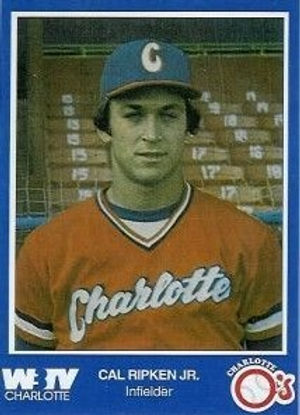

How do I spot a 1980 WBTV counterfeit?
Spotting a counterfeit blue Ripken is not as hard as it may seem, especially after you learn what to look for. As mentioned earlier, I strongly suggest buying a copy of the card that has been graded by a reputable grading company. PSA, SGC and BGS have all graded copies of this card and have a good idea in regards to what they are looking for. However, it may not always be possible to purchase an authenticated copy of this card. If/When you are in a situation to purchase an unauthenticated copy of this card, ask if the seller has the remaining cards of the set. Although this does not guarantee the authenticity of the Ripken or even the remaining cards in the set, in does increase the likelihood of the authenticity of the Ripken and/or the remainder of the set. This is a key Ripken card and another "must have" for the Ripken collector. However, this is an expensive card and one with a history of being a counterfeit. With that being said, be careful when provided with the opportunity to add this gem to your collection. Please note that this is a list of suggestions. As technology continues to advance it will become more difficult to know an authentic copy from a fake by appearance only.
There are ways that you can spot an authentic copy from the fake. Here are a few tips you can use, whether you are getting ready to add this card to your set or you are wanting to review your own card without sending it to a third party grading service:
The O's Logo on the Card
The color of the O's logo is the first sign of the authenticity of this card. Authentic copies of this card have a very bright orange O's logo, while fake variations of this card typically have a reddish-orange logo. For example, consider the logos below

This is the O's logo on the front of an authenticated copy of the 1980 WBTV Charlotte Orioles card of Cal Ripken, Jr. Notice the brightness of the orange is in the O's logo. Although this may not seem like much, consider the color of the logo on the left in contrast to the O's logo on a counterfeit.
This is the O's logo on the front of a counterfeit copy of the 1980 WBTV Charlotte Orioles card of Cal Ripken, Jr. When you see the distortion in the color of the logo, it is your first and biggest sign that the card you are looking at is a fake. For the record, the bright orange O's logo appears on the bottom right corner of all 28 cards in the WBTV set.
The Framing of the Ripken Picture
Possibly by a twist of fate, the white border that surrounds the image of the 19 year old infielder is a shield protecting collectors from counterfeit copies some 26 years later. On all of the cards in the set, the image is surrounded by a white border. On the Ripken card, the white border protects collectors in two ways:
First, the width of the vertical white line is greater on the right side than the left side on authentic copies of the WBTV Ripken. However, this probably isn't a worry for many willing to risk counterfeiting the card.
Second, the horizontal white line in the border isn't a perfect line at the top and bottom of the frame on an authentic WBTV Ripken. This is better explained visually:

The above image is of the top of a counterfeit WBTV Ripken. Not only is the top white line a perfect line, you will see that the vertical width of the left side is wider than the vertical width of the right side, which is inconsistent with the authenticity of this card. Compare this scan to a scan of an authenticated copy of the card:

The above image is the top of an authenticated WBTV Ripken. You will see that the top horizontal white line is not a perfect line and has a noticable dip and raise as it goes from the left side of the card to the right. In addition, you will see that the vertical width of the line on the left side of the card is slimmer than the vertical width of the line on the right side of the card. For the record, this is not the only time that a dip appears in the horizontal white line surrounding the image of Cal on the blue and orange Charlotte cards. In the next two images, you will see the horizontal white line on the bottom of an authentic and counterfeit 1980 Charlotte O's WBTV.

Top Lines on Authenticated WBTV and Charlotte Police Issues

Bottom Lines on Authenticated WBTV and Charlotte Police Issues
The Stock of the Cards
The authenticity of the set is also protected in something that actually hindered the ability to keep the set in great condition - the paper the cards were printed on. The paper that the blue and orange Charlotte cards were printed on was a very thin and flimsy stock. In fact, it is not uncommon to be able to see the printing from the back of an orange card when looking at the front of an orange card. The disadvantage of this tip is that to review the stock of the card, you have to purchase the card in person and/or be dealing with someone that is willing to let you take the card from its protective case.
The good news for you as a collector is that there are authenticated copies of the blue and orange Ripken Charlotte cards from time to time. However, in May of 2026 a counterfeit 1980 WBTV Charlotte O's Ripken in a PSA 8 slab appeared at auction before being pulled as bidding approached $13,000. The certification number was subsequently pulled from the PSA database.
In the event that you choose to go the route of buying a Charlotte Ripken card of Cal that has not been authenticated, be sure to look at the warning signs. In addition, remember that even with the tips provided above for spotting a fake, new advancements is made in technology every single day. As technology advances, the ability to recreate a more authentic looking copy of this card will take place. If I can ever be of any assistance, feel free to contact me at any time at ripkenintheminors@hotmail.com
Spotting a 1981 WTF Rochester Red Wings Counterfeit


As displayed above, the key area to examine is over Ripken's right shoulder, atop the roof. There should be a box shape -- a flag-like image or something similar -- on the very edge of the card. On the fake, most of this box has been obliterated.
Cal Ripken Jr. has become a representative for all that is good and fair in baseball, so much so that it's painful to see these kind of counterfeits emerge. Hopefully, with the right information, collectors can avoid these bogus cards.
Articles and images courtesy of http://www.beckett.com
In 2001, the great folks at Beckett.com conducted a series of articles on counterfeit cards in the market. The series included several cards of Cal, including the 1982 Donruss RC, 1982 Topps RC and 1982 Topps Traded RC. In part 16 of the series, Beckett took a close look at the 1981 WTF Rochester card of Cal Ripken Jr. Here is what the Beckett Grading Services Staff had to say in their 8/15/2001 report:
As Cal Ripken Jr.'s farewell tour progresses, it seems that a new influx of counterfeits has hit the market. It's quite common for new counterfeits to appear when a player suddenly enters (or re-enters) the national limelight. In Ripken's case, a small handful of new fakes have popped up suddenly. This week, we will look at the 1981 Rochester Red Wings WTF Ripken minor league card. Although not his highest priced minor league card, this tough team-issue is still one of the cornerstones of a Ripken collection. This fake is extremely tricky simply because most people are unfamiliar with minor league issues and have never seen the original card. As we've displayed below, held side-by-side to a genuine card, the bright white stock is easy to spot. However, most people do not have a genuine copy on hand for comparison. The genuine card is printed on an off-white card stock, nearly yellowed, or "dirty-white," as shown at left, whereas the fake/reprint is on vivid bright white stock. The original weighs much more than the fake (1.73 grams compared to 1.49 grams on the fake) although both cards feel fairly thin to the touch. The dot pattern is a mild giveaway, but it is very close to the original. Primarily, the fake will have more specks of white scattered about the front photo, and will have more areas of lightly broken text on the back.
May 2026: A PSA 8 Counterfeit 1980 Ripken WBTV Surfaces
In May 2026, Ripken in the Minors and its research were featured in a video produced by Junk Wax Hero, a sports card storyteller and collector whose content focuses on vintage and junk wax era baseball and basketball cards, with a particular emphasis on Hall of Fame autographs and the stories behind the hobby.
The video examined a counterfeit example of the 1980 WBTV Charlotte O's Cal Ripken Jr. card that surfaced in a major online auction and highlighted the importance of hobby research, card authentication, and historical documentation. The feature demonstrated how research conducted by collectors continues to help educate the hobby nearly fifty years after the card's release.